




Fallopia japonica
Polygonaceae
Japanese Knotweed
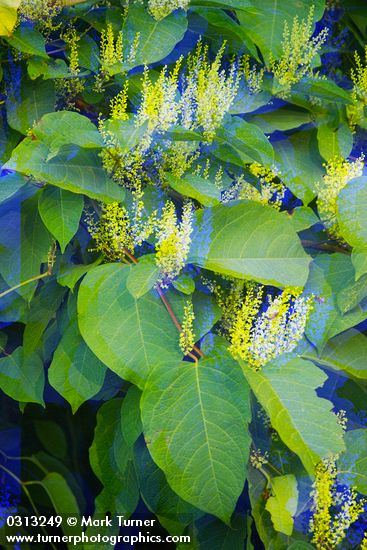
Dense mat with freely branched stems from spreading rhizomes. Male, female flowers on separate plants. Leaves on stem, 4–8 in. long, with shorter petioles, egg-shaped to round, often wider than long, sharply pointed tip. Inflorescence widely branched, 6 in. Flower stalks among leaves on upper stem, lengthening with age. Flowers white, 5-lobed. Grows on wet ground, disturbed places, at low to mid-elevations. Polygonum bohemicum (pictured) is a newly identified hybrid between P. cuspidatum and P. sachalinense, giant knotweed, which is erect and 6–9 ft. tall. Differences among the 3 are primarily the size and shape of leaves. All are considered noxious weeds and will crowd out native vegetation.
- Rarity: Common
- Flowering Time: Early Summer, Mid Summer, Late Summer
- Flower Form: 4-6 petals, flowers in clusters
- Life Cycle: Perennial
- Height: 3–8 feet
- Habitat: Bog/Fen/Wetland, Disturbed
- Found In: Mt. Rainier NP, N Cascades NP, Olympic NP
- Native: No
- Latin Synonyms: Polygonum cuspidatum, Reynoutria japonica
