



Urtica dioica
Urticaceae
Stinging Nettle
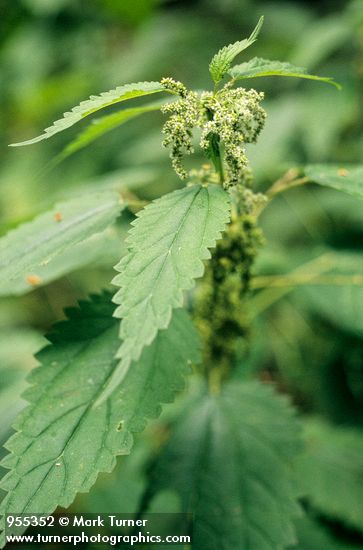
Clustered, erect, leafy stems with spreading roots and stinging hairs. Leaves opposite, lance- to heart-shaped, 2–6 in. long, coarsely toothed. Inflorescence consists of drooping catkin-like stalks from leaf axils holding dense clusters of small greenish flowers. Female flowers in separate clusters near top. Grows in moist deep soils in meadows, forests, shrubby places, sometimes in thick patches in disturbed places. Can cause painful rash if touched. Subsp. gracilis is green, with nonstinging hairs only on stem and lower leaf surface. Subsp. holosericea has gray-green stems, dense nonstinging hairs only on lower stem and lower leaf surface. Stinging hairs cover other surfaces on both varieties.
- Rarity: Common
- Flowering Time: Early Spring, Mid Spring, Late Spring, Early Summer, Mid Summer, Late Summer
- Flower Form: Petals 4
- Life Cycle: Perennial
- Height: 3–9 feet
- Habitat: Coastal, Disturbed, East-side Forest, Meadow, Moist Riverbanks, Shrub-Steppe, West-side Forest
- Found In: Crater Lake NP, Mt. Rainier NP, N Cascades NP, Olympic NP, Steens, Wallowas, West Gorge
- Native: Yes
